Panayotis D. Cangelaris - Greek Diplomat and Collector
 

"THE MAFEKING BLUES 1900"

 Philatelic Exhibit


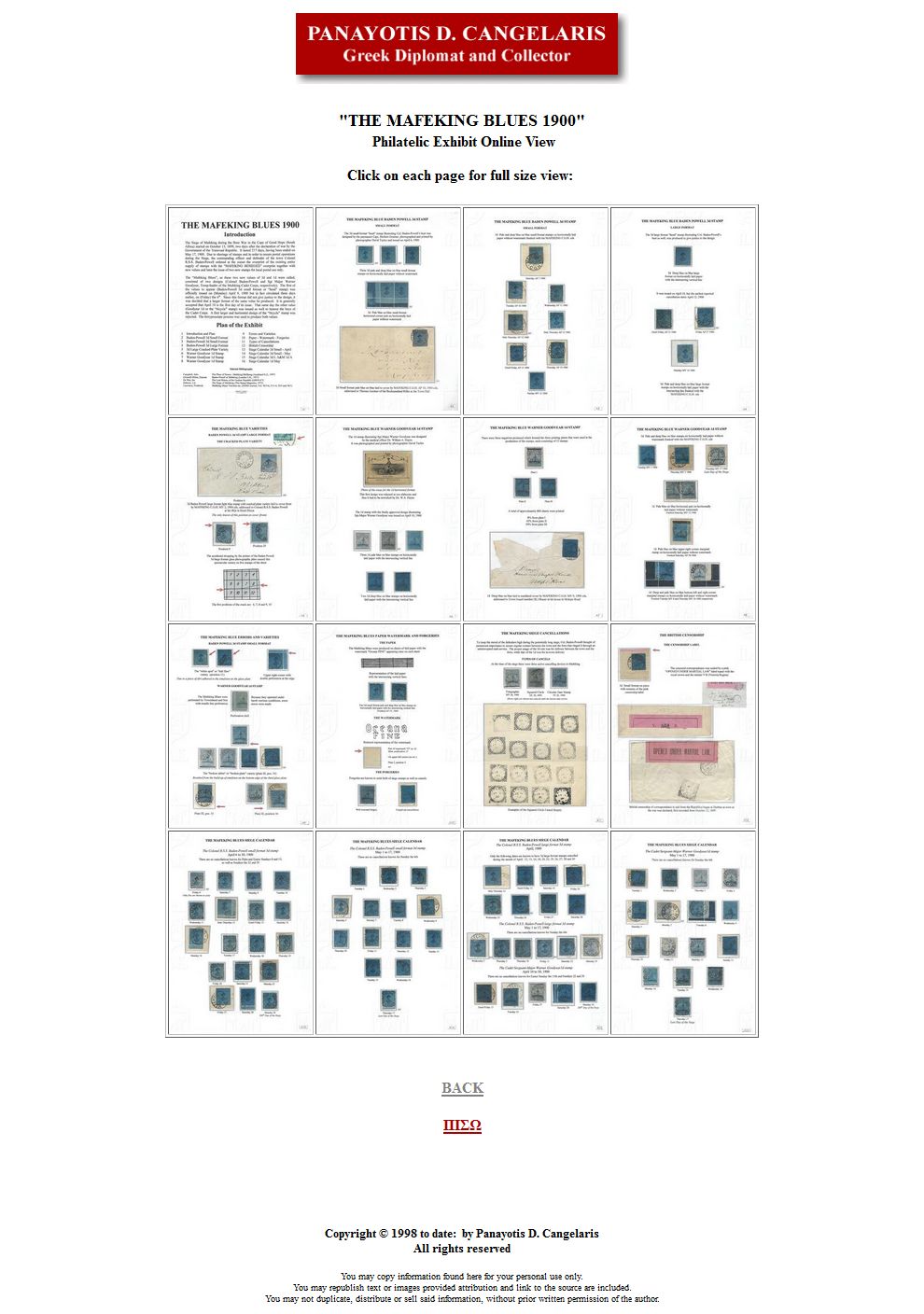
 This exhibit refers to the two blueprint values issued during the siege of Mafeking in order to be used locally for the exchange of correspondance in-town and between the town and the forts.  It is divided in three main parts:

(1)  The 3d Small Format Col. Baden-Powell "head" Issue
(2)  The 3d Large Format Col. Baden-Powell "head" Issue
(3)  The 1d Cadet Corps Sgt. Maj. Goodyear "bicycle" Issue

[An introduction and a sample from the material contained in the exhibit are shown here]


Introduction

The Siege of Mafeking during the Boer War in the Cape of Good Hope (South Africa) started on October 13, 1899, two days after the declaration of war by the Government of the Transvaal Republic.  It lasted 217 days, having been ended on May 17, 1900.  Due to shortage of stamps and in order to assure postal operations during the Siege, the commanding officer and defender of the town Colonel R.S.S. Baden-Powell ordered at the outset the overprint of the existing entire supply of stamps with the “MAFEKING BESIEGED” overprint together with new values and later the issue of two new stamps for local postal use only.

The “Mafeking Blues”, as these two new values of 3d and 1d were called, consisted of two designs (Colonel Baden-Powell and Sgt Major Warner Goodyear, Troop-leader of the Mafeking Cadet Corps, respectively).  The first of the values to appear (Baden-Powell 3d small format or “head” stamp) was officially issued on (Monday) April 9, 1900 but in fact circulated three days earlier, on (Friday) the 6th.  Since this format did not give justice to the design, it was decided that a larger format of the same value be produced.  It is generally accepted that April 10 is the first day of its issue.  That same day the other value (Goodyear 1d or the “bicycle” stamp) was issued as well to honour the boys of the Cadet Corps.  A first larger and horizontal design of the “bicycle” stamp was rejected.  The ferroprussiate process was used to produce both values.
 
 The "Mafeking Blues" Stamps


 The 3d small and large format "head" stamps and the 1d "bicycle" stamp printed on horizontally laid paper.


 The 3d Small Format Col. Baden-Powell "head" Issue
 

The 3d small format “head” stamp illustrating Col. Baden-Powell’s bust was designed by the paymaster Capt. Herbert Greener, photographed and printed by photographer David Taylor and issued on April 6, 1900

Friday, AP 6, 1900

Only five are known to exist


3d  Pale blue on blue small format horizontal corner pair on horizontally laid paper without watermark


 3d Small format pale blue on blue tied to cover by MAFEKING C.G.H. AP 10, 1900 cds, addressed to Thomas Gardner of the Bechuanaland Rifles at the Town Hall

 
The “white spot” or “ball flaw” variety  (position 11)
Due to a piece of dirt adhered to the emulsion on the glass plate
Upper right corner with double perforation at the edge


3d  Small format on piece with remains of the pink censorship label (picture on the left)

The censored correspondence was sealed by a pink “OPENED UNDER MARTIAL LAW” label toped with the royal crown and the initials V R (Victoria Regina)


 The 3d Large Format Col. Baden-Powell "head" Issue


The 3d large format “head” stamp illustrating Col. Baden-Powell’s bust as well, was produced to give justice to the design.  It was issued on April 10, but the earliest reported cancellation dates April 12, 1900

3d Baden Powell large format light blue stamp with cracked plate variety (position 6) tied to cover front by MAFEKING C.G.H. MY 2, 1900 cds, addressed to Colonel R.S.S. Baden Powell at his HQs in Hotel Dixon

The only known of this position on cover (front)


The cracked plate variety (position 9)

The accidental dropping by the printer of the Baden Powell 3d large format glass photographic plate caused this spectacular variety on five stamps of the sheet (positions 6, 7, 8, 9 and 10)
 
  The 1d Cadet Corps Sgt. Maj. Goodyear "bicycle" Issue
The 1d stamp illustrating Sgt-Major Warner Goodyear was designed by the medical officer Dr. William A. Hayes and photographed and printed by photographer David Taylor.  It was issued on April 10, 1900

Photo of the essay for the 1d horizontal format

This first design was rejected as too elaborate and thus it had to be reworked by Dr. W.A. Hayes
There were three negatives produced which formed the three printing plates that were used in the production of the stamps, each consisting of 12 stamps.  A total of approximately 800 sheets were printed, 8% from plate I, 42% form plate II and 50% from plate III
Plate I Plate II Plate III

1d  Pale blue on blue horizontal pair on horizontally laid paper without watermark franked Saturday MY 12 1900

1d  Deep and pale blue on blue bottom left and right corner marginal stamps on horizontally laid paper without watermark

Franked Tuesday MY 8 and Thursday MY 10 1900 respectively
1d  Deep blue on blue tied to mutilated cover by MAFEKING C.G.H. MY 9, 1900 cds, addressed to Town Guard member (R.) Brazer at his house in Molopo Road
Errors - Varieties - Forgeries - Cancellations

The “broken tablet” or “broken plate” variety (plate III, pos. 33-36)

Resulted from the build-up of emulsion on the bottom edge of the broken third glass plate
Perforation shift

Because they operated under harsh wartime conditions, some errors were made
Well executed forgery Forged cds cancellation
Circular Date Stamp (FE 30, 1900) Squared Circle (OC 30, 1899)
At the time of the siege there were three active cancelling devices in Mafeking:  Telegraphic, Squared Circle and Circular Date Stamp

Above are shown two
cancels with the known date errors

Return to page:

Philatelic Collection


Ελληνικά


Copyright © 1998 - 2011  by Panayotis D. Cangelaris
All rights reserved

You may copy information found here for your personal use only.
You may republish text or images provided attribution and link to the source are included.
You may not duplicate, distribute or sell said information, without prior written permission of the author.