| |
 |
| |
|
"THE WESTERN THRACE AUTONOMOUS GOVERNMENT
"MUHTARIYET" ISSUE
(1913)"
|
| Philatelic
Exhibit
|
|
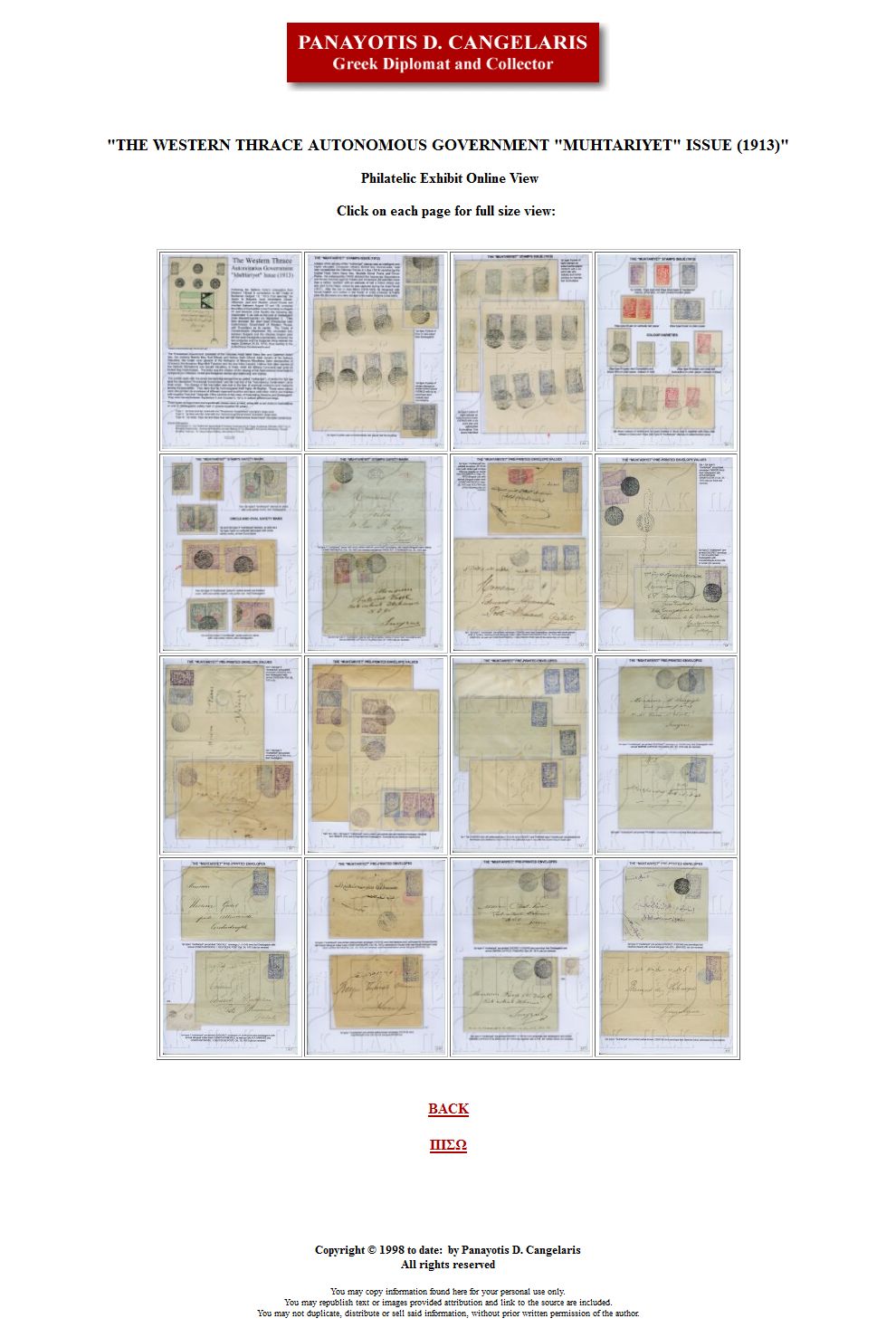
| This exhibit refers
to the seven so called "Muhtariyet" handprinted stamps of
whom the first two bear the inscription “Provisional
Government” and the rest that of the “Autonomous
Government”, all in Arab script.
It is
divided in three main parts:
(1) The
"Muhtariyet" Stamps Issue
(2) The "Muhtariyet" Stamps Safety Mark
(3) The "Muhtariyet" Pre-Printed Envelopes and Cancels
[An introduction
and a sample from the material
contained in the exhibit are shown here]
|
|
|
Introduction
Following the Hellenic
Army’s evacuation
from Western Thrace in compliance to the Treaty of Bucharest (August
10, 1913) that awarded the region to Bulgaria, local inhabitants
(Greek, Armenian, Jew and Muslim) joined forces and revolted (between
August 16 and 19), occupied the cities of Gumuldjina (now Komotini) on
August 31 and Isketche (now Xanthi) the following day (September 1) as
well as the port of Dedeagatch (now Alexandroupolis) on September 3. They
then declared the short lived
(Provisional later Autonomous) Government of Western Thrace, with
Gumuldjina as its capital. The Treaty of
Constantinople (September 29), concluded only between Bulgaria and the
Ottoman Empire (who left the local insurgents unprotected), removed the
last obstacles and the Bulgarian Army entered the region (October
25-30, 1913), thus leading to the Autonomous Government’s end.
The
Provisional Government consisted of the militaries Hadji Selim Samy Bey
and Suleiman Askeri Bey, the civilians Reshid Bey, Raif Effendi and
Hafous Salih Effendi (later senator of the Hellenic Republic), the
Greek vicar general of the Bishopric of Maronia Nicodimos (later
metropolitan of Grevena), the Armenian Migirditch Tabakian and the Jew
Yaka Cassavi. Hafous Gali
(later member of
the Hellenic Parliament) was named Secretary of State, while the
Military Command was given to Eshref Bey Kushchubasi.
The
latter was the initiator of the issuing of the
Autonomous Government’s overprints (on Ottoman, Greek and
Bulgarian stamps and stationery), as well as of these stamps.
He was
an intelligent and highly educated Circassian
military, who later commanded the Ottoman Forces in Libya (1914)
assisted by his brother Hadji Selim Samy Bey, Mustafa Kemal Pasha and
Emver Pasha. He subsequently
(1916)
directed the massacres, deportations and forced marches against Greeks
and Armenians (he admitted more than a million
“purified”
with an estimate of half a million killed) and was sent to the Hejaz,
where he was captured during the Arab Revolt (1917).
After
the war in Asia Minor (1919-1922) he disagreed
with Kemal Atatürk and
settled in the Island of
Crete (Greece) to finally pass his last years at a very old age in his
native Smyrna (now Izmir).
The change of
the inscription (from “Provisional Government” to
“Autonomous Government”) was due to the fear of
eventual confusion
and insecurity among
the population. The stamps were
died by
local engraver Halil Oglou Ali Moullah. These
same values were also printed on envelopes of different sizes and
qualities and were sold either mint or pre-franked with negative Post
and Telegraph Office cancels of the cities of Gumuldjina, Isketche and
Dedeagatch. They were issued
between
September 8 and October 6, 1913, in sixteen different printings.
Three types of ungummed and
imperforate stamps
were printed, some with a red circle (in Gumuldjina) or oval (in
Dedeagatch) safety mark (1 piastre equalled 40 paras):
Type I: 1pi
blue and 2pi violet with the
“Provisional Government” inscription (large size)
Type
II: 1pi blue and 2pi
violet with the
“Autonomous Government” inscription (large size)
Type III: 1pi
violet, 10pa red and 20pa blue with the
“Autonomous Government” inscription (small size)
|
|
The
"Muhtariyet"
Stamps Issue
|
| |
|
|
|
The 1pi
(violet), 10pa (red) and
20pa (blue) type III "Muhtariyet" stamps, small size, on plain
unwatermarked paper.
|
|
|
2pi
(blue instead of violet) and
1pi (grey instead of blue) type II, large size, together with 20pa (red
instead of blue) and 10pa (red) type III "Muhtariyet" stamps, small
size, on watermarked pane.
|
|
The
"Muhtariyet"
Stamps Safety Mark
|
|
|
|
| 1pi
and 2pi type II "Muhtariyet" gutter pairs on piece, with oval safety
marks, tied Dedeagatch.
|
|
|
|
|
| 1pi
pair and a 2pi on piece type II "Muhtariyet" stamps on vertically laid
paper, with circle safety marks, tied Gumuldjina.
|
|
|
|
1pi
type II "Muhtariyet" stamp with circle safety mark on cover tied
Gumuldjina, with transit bilingual meter stamp CONSTANTINOPLE Oct. 19,
1913 (on reverse) and arrival PARIS R.P. ETRANGER Oct. 24, 1913 cds.
|
|
|
1pi
and 2pi type II "Muhtariyet" stamps with circle safety mark on cover
tied Gumuldjina and arrival SMIRNE (UFFICIO ITALIANO) Oct. 27, 1913 cds
(on reverse).
|
|
|
The
"Muhtariyet"
Pre-Printed Envelopes and Cancels
|
|
|
1pi
type I "Muhtariyet" pre-printed envelope (111X143 mm) with added pair
of 20pa Ottoman stamps on transit tied ANDRINOPLE Sept. 24, 1913
bilingual meter mark CONSTANTINOPLE Sept. 26, 1913 and SCUTARI cds of
the following day (on reverse).
|
|
|
|
1pi
type I "Muhtariyet" pre-printed "ELEGANT" envelope (111X143 mm) tied
Dedeagatch with arrival SMIRNE (UFFICIO ITALIANO) Oct. 27, 1913 cds (on
reverse).
|
|
|
|
1pi
type I "Muhtariyet" pre-printed "PANAMA" envelope (111X143 mm) tied
Gumuldjina addressed to Smyrna
|
|
|
|
2pi
type II "Muhtariyet" pre-printed "DISCRET" envelope (110X143 mm) tied
Dedeagatch with Constantinople arrival cds in Arab script (on reverse).
|
|
|
|
1pi
and 2pi type II "Muhtariyet" pre-printed envelope (117X180 mm) tied
Gumuldjina.
|
|
|
|
1pi
type I "Muhtariyet" pre-printed envelope (111X143 mm) tied Isketche
(red cancel) addressed to Proussa (Bursa) with transit bilingual meter
mark CONSTANTINOPLE Oct. 16, 1913, redirected to SCUTARI with new
transit bilingual meter mark CONSTANTINOPLE Oct. 19, 1913 (on reverse)
and final destination arrival bilingual cds.
|
|
|
|
2pi
type II "Muhtariyet" pre-printed "DISCRET" envelope (110X145 mm) tied
Isketche (black cancel) with arrival bilingual GALATA-ARRIVÉE
cds (on reverse).
|
|
|
|
2pi
type II "Muhtariyet" pre-printed yellow-brown envelope (128X195 mm)
tied Isketche (blue cancel) addressed to Gumuldjina.
|
|
|
To
view the full exhibit online, please click here
To
view a related article, please click:
Gumuldjina
1913
Ελληνικά
Copyright
© 1998 to date: by Panayotis D. Cangelaris
All rights reserved
You
may copy
information found here for your personal use only.
You
may republish text or images provided attribution and link to the
source are included.
You
may not duplicate, distribute or sell said information, without prior
written
permission of the author.
|
|